Intel CorporationeShareholder | eShareholder
The finance engine that drives YOUR investment Font Size: Increase Font Size Reset Font Size Reduce Font Size Contact Home
Netbasis

    Ticker Quotes

    box bottom

    Historical Data

    box bottom

    Company News

    box bottom

Welcome Intel Corporation Shareholders!

Netbasis will automatically calculate your adjusted cost basis for Intel Corporation, or any Intel Corporation-affiliated company.

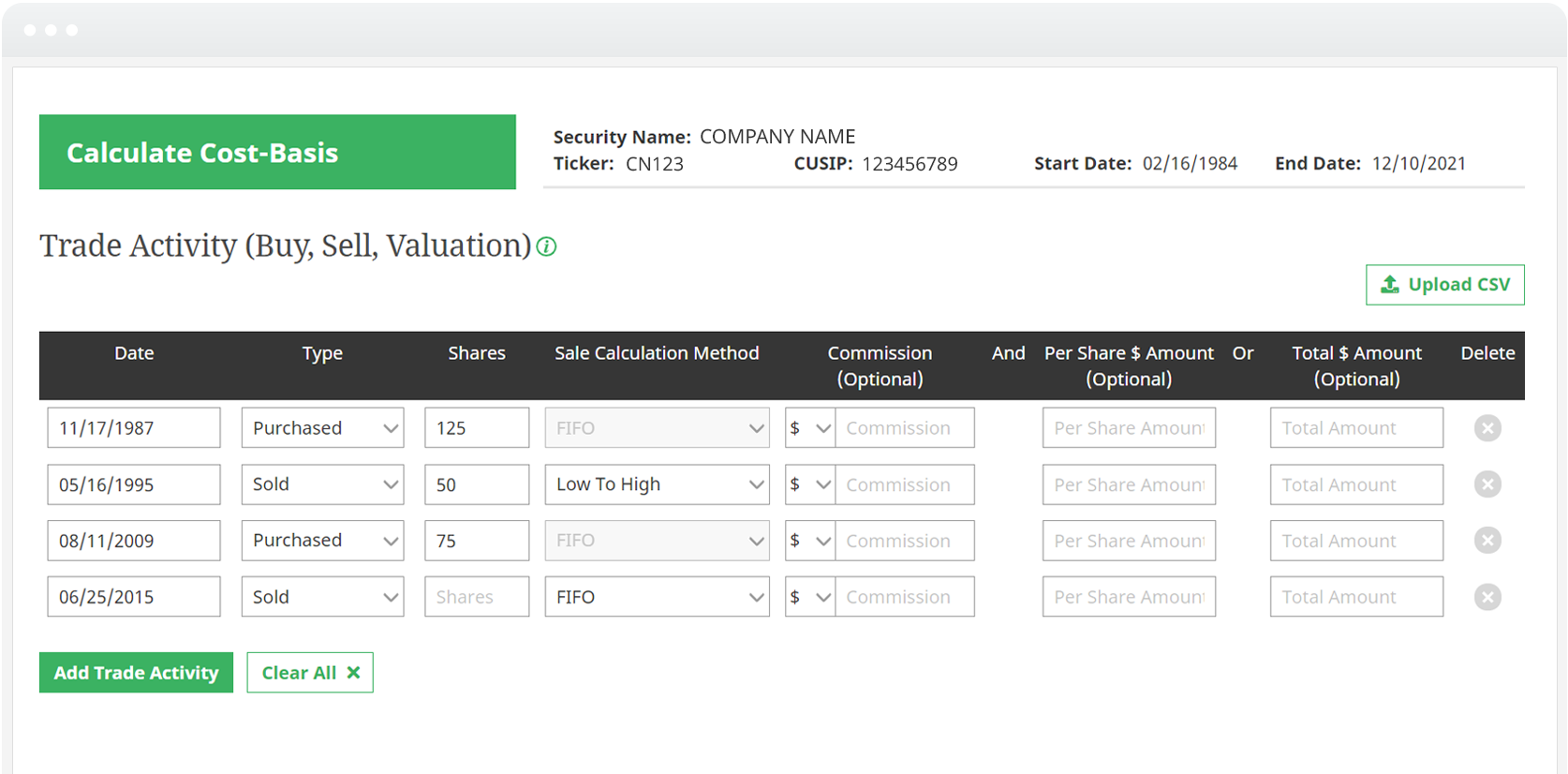
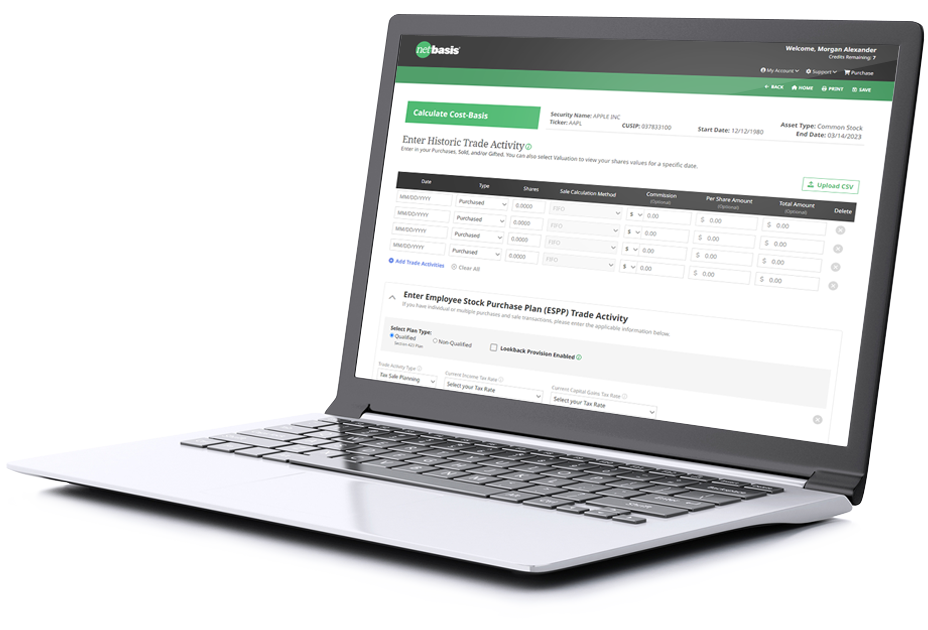
Calculate Cost Basis

A purchase of one Netbasis transaction for $19.50 will provide you with:

  • The information and documentation needed to calculate your capital gains for tax purposes
  • A historical reconstruction of your investment including all corporate actions and dividend re-investments
  • The ability to optimize your tax strategy by selecting from a variety of sale methods
  • Pricing and corporate actions for your securities

Netbasis contains all of the pricing and dividend history including all splits, mergers and any other corporate action. Netbasis does not contain your personal purchase and sale history.

You will need to enter:

  • The number of shares (or dollar amount) you originally purchased
  • The purchase date
  • The number of shares (or dollar amount) you sold
  • The sale dates

This information can often be found on several types of investment documents including: broker and transfer agent statements, your 1099 statement or pay stubs.


If you have questions please email us or call us at 1-888-80-basis.


Tax Information Center
  • What is cost basis?
    Cost basis is the value or price that you paid for a security plus any commissions. If the security experienced any corporate events, such as splits, spin-offs or dividend reinvestments, during the time that you owned your shares, then your original cost and shares must be adjusted for these actions. For example, you purchased 200 shares of ABC Company 2 years ago for $25 per share for a total original cost basis of $5,000. A year after you purchased those shares, the company underwent a 2:1 split (which means for every one share you originally owned, you now have two), so you now have 400 shares. To calculate the adjusted cost basis per share, you divide the original cost basis ($5,000) by the new number of shares (400), and your adjusted cost basis per share is now $12.50. Your shares doubled but the cost per share went down because you are spreading your original cost basis across twice as many shares after the split.
  • What are capital gains/losses?
    The capital gain or loss is the difference between the market value of your stock and the adjusted cost basis. When you sell a portion or all of your security, you must report your capital gains on your tax return. For example, five years ago, you purchased 100 shares of XYZ Company at $10 per share, which means your original cost basis was $1,000. The price of the company increased to $20 per share and you want to sell all of your shares. You would subtract the original cost basis of $1,000 from the new value of your shares which is $2000. The difference of $1000 is what has to be reported as capital gains. If the new value of your shares had gone down to $5 per share, then the difference would be $500 which would be reported as a capital loss of $500 from the original cost basis of $1000.
  • My broker provides the cost basis for uncovered securities. So I'm okay, right?
    New cost basis requirements that became effective January 1, 2011 mean that taxpayers are ultimately responsible for the accuracy of the cost basis figures reported on their Schedule D. So, if your Schedule D is audited and the IRS finds a misreported amount, you are ultimately responsible and face possible fines, even if your broker provided you with the figure in question! Prudent investors can double check the cost basis reported by their brokers using Netbasis, the professional and accurate cost basis solution.
  • Can your Schedule D pass an IRS audit?
    With new regulations that came into effect on January 1, 2011, the IRS is now focusing on the accurate reporting of gains or losses on the sale of stock. Taxpayers are now required to accurately report on a Schedule D the adjusted cost basis used to calculate the capital gain/loss. If you sold stock last year, the IRS may pay extra attention to your Schedule D to make sure that you accurately reported your cost basis. Are your cost basis figures accurate enough to pass an IRS audit? If you aren't sure, calculate your cost basis with NetWorth Services' Netbasis, the recognized and trusted cost basis solution.
  • What is a wash sale?
    A wash sale is an illegal strategy or series of transactions where an investor simultaneously purchases and sells shares of the same company, usually through different brokers, in order to create the illusion of a tax loss without really giving up their position in that security. With the enforcement of the IRS Wash Sale Rule, which states that an investor cannot report a loss on an investment that was purchased 30 days before or after the sale, the IRS quickly eliminated the effectiveness of the wash sale strategy.
  • How can I get my cost basis?
    Typically, investors calculate the cost basis themselves using years' worth of brokerage statements and a calculator. This can be a complex, confusing and complicated task; and the longer the holding period for the stock and the more complicated its corporate history, the greater the risk of an inaccurate end result. However, there is an easier way. Use Netbasis, the simple and trusted solution that calculates cost basis for even the most complicated of holdings.
  • Are my other investments affected by the cost basis regulatory changes?
    Because EESA's requirements are being rolled out in three phases, the following securities will be affected as follows: January 1, 2011 - Equities; January 1, 2012 - Mutual funds, stock acquired in a dividend reinvestment plan (DRIP) and electronic funds transfer (EFT's); January 1, 2013 - Fixed income and options.
  • How does the new cost basis legislation affect me?
    Investors must be aware of how the new cost basis legislation will affect them. In 2008, Congress passed the Emergency Economic Stabilization Act (EESA), the so-called "Bailout Bill." Included in the bill are cost basis provisions which require that beginning January 1, 2011, brokers and other financial intermediaries must provide their customers with the cost basis of "covered securities." Covered securities are those purchased on or after January 1, 2011. "Uncovered securities" are those purchased before January 1, 2011. You need to be concerned about your uncovered securities. Brokers and other financial intermediaries are not required by law to report the cost basis for uncovered securities. If your broker does not provide the cost basis for your uncovered securities, you will need to calculate the cost basis yourself. The new regulations also mean increased fines for underreporting capital gains. You, as the investor, are ultimately responsible to the IRS for ensuring that capital gain and loss amounts are correct; and as a result, it is very important that your cost basis calculations are exact.

Netbasis Visit our estore

Company Profiles